Showing posts with label Random reviews. Show all posts
Wednesday, 12 August 2015
'Ultradistancia' - Federico Winer
http://www.ultradistancia.com
Jorge Luis Borges’ fragment ‘On Exactitude in Science’ describes a map that has been created by perfectionist geographers to cover the entire territory, a piece that seems strangely prophetic in the age of Google Maps.
With the Googlisation of the world proceeding at an exponential rate, from the mapping of metropolises, deserts and even coral reefs, the formal space of the art exhibition has also been colonised by the digital. Google Art Project aims to virtualise the world’s art galleries, allowing anyone to wander the wings of the Louvre or Prado without leaving the frame of their own home.
With this in mind, it was inevitable that artists would respond to developments such as these by using Google itself as a means of crafting new art.
A compatriot of Borges, the Argentine photographic-artist Federico Winer’s latest series ‘Ultradistancia’ seeks to transcend the way we look at the world by taking elaborate ‘trips’ across Google Maps and capturing some truly arresting and hypnotic images.
By manipulating colour contrast and saturation, the pieces cannot fail but have an immediate impact on the viewer; psychedelic, and at once disorientating yet strangely familiar from our own personal brushstrokes across the same digital canvas.
Exposed to this satellite perception, the built and natural environments collide in a revelation of patterns and forms that are each weighted with their own imaginative potency.
A car park is revealed as an intricate micro-circuitry board, each tiny vehicle charged with the movement of data between unknown destinations. A hypodermic pier punctures the tissue of the shoreline. The impossibly blue Miami sea is scattered by small boats that float like fallen leaves. Vast highways become reams of fibre-optic cables just as spiralling motorway junctions become rhizomes shooting and twisting from out of the ground.
Planes are lined up in neat rows on an airport concourse like butterflies under the careful hands of a lepidopterist. The modernist architecture of a rail terminus unfolds like a lotus flower, while the graticule choreography of the urban cityscape is juxtaposed with the lysergic lily pads of circle-irrigated fields.
Each image is also freighted with the obliteration of scale, forcing the viewer to call into question their own impressions of micro and macro, frustrated by the stricture of the perspective prohibiting the customary zoom in or out.
The more they are observed, the more artistic movements seem to be subliminally embedded within each of the images.
From the luminous and brooding tones of a Rothko canvas; to the desiccated deserts of Max Ernst; the tessellations of M.C. Escher; the intensity of Jackson Pollock’s ‘Alchemy’, and the bold lines of Vorticism. Intentionally or not, several of the pieces seem to imply the grid-shaped tableaus of Piet Mondrian, equally illustrating the inexplicable spiritual structures thought to underpin the world of experience.
Being a political philosopher as well as an artist, it is hard not to ruminate on the wider connotations of Winer’s work.
So redolent of the contemporary is ‘Ultradistancia’ – satellites, drones and virtual mapping – that it’s tempting to pinpoint the series as a pioneering example of what could become an entirely new artistic movement, ‘dronism’ perhaps.
Art that encompasses the perspective of the ‘artificial eye’ roving at a remove from human influence, at the same time exploiting the new technologies of the masses to present a new and sublime interpretation of the world.
Indeed, what becomes quite striking about the 40 images is the lack of any captured human agency. Instead, human infrastructure and architecture are frozen in isolation as though they were ancient hieroglyphs left on cave walls for future observers, who may in their own way try and decode the true meanings and relevance of arterial slip roads and the uniformity of suburban street design.
In a shrinking 21st century world of ubiquitous surveillance and digital coverage, the omniscient vantage points of Winer’s online ‘trips’ provide a unique glimpse of a planet increasingly shorn of its secrets, only to reveal geometries that hold a mysterious ambiguity all of their own.
Thursday, 11 June 2015
REVIEW: Laurence Scott - 'The Four-Dimensional Human: Ways of Being in the Digital World'
If the noughties was the decade in which the digital revolution liquefied before evaporating into clouds, so far this decade seems set on warning of brewing storms of discontent and the increasingly acidic rain trickling down the glass between our human and online selves. The catalogue of Cassandras decrying the digital is now considerable and so it is a minor relief to find Laurence Scott's debut book adopting the ambivalent, indeed almost mildly approving, tone of J.G. Ballard towards the technological zeitgeist.
A recent Ofcom survey found that Internet users aged 16 and over now spend around 27 hours a week online. With this kind of statistic in mind Scott presents the view that the internet now saturates the contemporary world and the minutiae of our lived experience to such an intense degree that the digital has come to represent a fourth dimension. In a way, Marcuse's theory of the 'One Dimensional Man' as a blank canvas flattened by 20th century capitalism and scientific rationalism has been hoisted aloft by the centre pole of the hyperreal.
The Situationists were writing about the possible response of the individual to the post-modern ‘spectacle’ of cybernetics and the consumer culture decades before anyone had any notion of an online self that could be categorised as four-dimensional. Whereas writers such as Guy Debord saw the response, in the socio-political context of 1968, as revolutionary in nature, Scott, as much in tune with the spirit of his own generation as Debord, prefers to channel ambivalence and nostalgic distraction.
As such, the book builds upon the semiotic scaffold of Umberto Eco with his 'Travels in Hyperreality’, exploring the communal loneliness and 'melancholia of inconsequential proximity' that radiates like a dull ache through the glare of the now-digitised spectacle.
Scott is successful in capturing a bounty of incidental emotions and impulses that characterise the fourth dimension. He scrutinises the skeuomorphs of digital life, the banal neologisms ('VoiceChat', 'life hacks'), the resurgence of Gothic terminology (trolls, ghosts, stalking), and the unstoppable digitisation of the physical landscape by Google Maps. He also pinpoints the creative artist's increasing struggle for particularity with Google immolating any pretensions to original thought; the sense of entrapment in the compulsive go-round of websites; and describes the 'ship-in-a-bottle feelings...the pocket-sized shipwreck that occurs when an inbox shows us, with treacherous indifference, the pale, empty horizon of read emails.'
Peppered with great aphoristic sentences such as this, and largely devoid of the weighty sociological academe of the Frankfurt School writers, the book succeeds through its striking readability. Like the philosopher John Gray, Scott favours as imaginative touchstones for his theories the lessons from literature, poetry and age-old myths that resonate through cultures and ride in the slipstream of accelerating technologies.
Writers such as Henry James, Herman Melville and James Joyce are invoked alongside a mish-mash of ephemera from Mr Men to Love Actually, Seinfeld to Who Wants To Be A Millionaire, scored through with autobiographical vignettes. It feels like it shouldn't work, and some points lack the cohesion of others, but curiously the overriding impression is one of reading an accurate textual portrayal of the scattered and disparate internet experience itself.
The potency of Scott's associative thinking is what gives the book its vitality. He frequently engineers collisions between two ostensibly unrelated events that explode into new possibilities of interpretation. In terms of contemporary perspective, James Lovelock's Gaia theory of equilibrium is taken as the macroscopic apocalyptic view of the world counter-weighted by the gossip columns of Katie Price as the microscopic celebrity non-event.
Similarly, the Marxian process of reification being brought to bear on the powers of the digital information economy to commoditise the past is the tune to which the 2011 John Galliano scandal is made to dance a tenuous bolero with the exposure of LSE and several pop stars' financial links to the Gaddafi regime. The ice is slippery but the theory somehow manages to stay on its feet.
For all its strengths, there is the inescapable impression that the book is conspicuous by what it chooses to overlook. Considering the subtitle 'Ways of being in the digital world', there is barely anything on the way primal instincts of human nature - sex and violence - have been recalibrated in the digital dimension, whereby one can traverse from hardcore pornography to desert videos of Isis beheadings in an evolutionary supernova of clicks.
The book is similarly light on historical contextualising. It is a shame there is no examination of Edward Bernays and the way in which public relations became an engine for manufacturing mass control and docility through rapacious consumption, turning us into 'happiness machines', which would seem to be the direct paradigm for today's 'clicktivism' and self-promotion through social media.
The future is given similar short-shrift; the author seems reluctant to posit a forward view or indicate a possible direction of travel, which considering the bounteous scope for discussion - anonymity and privacy post-Snowden, the Singularity, transhumanism, the 'Internet of Things' and its proposed impact on our experience of urban space - feels like something of a missed opportunity. Scott pins vignettes and canny observations under glass like a lepidopterist, noting their unique markings before letting them flutter away without consequence, which adds to the book's readability even if occasionally you long for them to be bulked out with the taxidermy of interrogative thought.
Overall though, one could be forgiven for thinking that given the frantic exponential rate of online change (an average website's lifespan is now reputed to be around 18 months), this apposite and witty exploration of the digital quotidian could, by being so focused on contemporary mores, be rendered strangely out-of-date by the time it even gets to a paperback edition. On the basis of this debut work though, it is clear the author's career may have rather more longevity.
Friday, 30 January 2015
REVIEW - 'Accepting Reality: The University Years' - Saimon A. King
Growing up in Chile, only moving to England at age 11, King’s prose contains within itself the ambivalence and aloof alterity of the natural ‘outsider’, most discernible when occasionally attempting to characterise the quotidian or the mundane, as opposed to his preferred portrayal of the beleaguered obsessive, lost in a tempest of solitude, introspection and isolation-induced despair.
He often takes as inspiration the lives of figures such as Olivier Messiaen in a touching story reflecting on the transcendental quality of art (‘Quartet for the end of time’); the obscure pre-Socratic philosopher Heraclitus in a story about all the chance moments of history expunged in the flames of time, while others manage to resist the perpetual flux to become mythology (‘Consigned to Mythology’); and the Russian writer Nikolay Gogol who, in a fit of spiritual despair, was impelled to destroy his work (‘Burned Manuscripts’). The intellectual intent of these experimental pieces is evident; King is seeking to explore the parameters of his own psyche, his foibles and motivations through the lens of these seminal true-life figures.
Written over a period between 2011 and 2014, the stories gain in strength as they progress which is promising in and of itself. What is equally promising is that, in parallel, the initially overt influences on his work begin to fade to the periphery; evidence of a gradual but very definite formulation of his own ‘voice’.
Indeed, the first story ‘8pm in Buenos Aires’, depicting the protagonist’s wanderings around the Argentine capital having just watched Woody Allen’s ‘Midnight in Paris’, resurrects several of those foremost South American influences as ghosts – Jorge Luis Borges, Julio Cortazar, Roberto Arlt.
King’s predilection for political theory, for philosophy and for the creative arts frequently enforce their weight upon the texts; more than once reflecting upon the importance of the literary canon and intellectual enquiry as being the most profound mode of existence. There seems to be a constant tug-of-war between rational pragmatism and irrationality, even nihilism, being waged through the stories alongside a quest for understanding and self-realisation (most successfully, I felt, in the Borgesian tale ‘The Hermit and the Despot’).
For all of his periphrastic ambition, King’s style is still, one can discern easily, of an inchoate form (as he himself concedes in the Preface, ‘several stories are clumsily written’). He occasionally seems to stumble over his own feet with jarring turns-of-phrase that sit more than a little uncomfortably; delinquent phrases tossed like stink-bombs down the otherwise elegant corridors of his prose. He can be prone to the odd clunky solecism (for instance, ‘verminous liquid’, ‘motes of dust coaxed over...’), and clichés that do disservice to the high-minded frame of the narrative (for instance, ‘drink like a fish’, ‘I slept like a log’, and particularly, a cringe-worthy sexual metaphor involving Dracula).
Such quibbles regarding a formative writing style aside however, the wealth of imaginative ideas is palpable, particularly, to my mind at least, in the pieces that King himself appears keen to disregard in the afterword. There is the joyously nonsensical absurdism of ‘Hit the North!’, in which an inhabitant of a flourishing neoliberal South of England takes a bizarre journey to the nuclear wasteland of the north, encountering Mark E. Smith who has become the immortal leader of a mutated Fall. There is also the Freudian screenplay ‘My Vinyl Fetish’ in which six characters, five of whom appear to be different manifestations of King’s personality, sit around and discuss Captain Beefheart, Van Morrison and Bach records.
Ironically, where King’s writing is at its most comfortable, assured and imagistic is the incidental piece ‘Valperaiso’ (dismissed in the afterword as an experiment in naturalism), which belies the versatility and future potential of his work.
As oblique, ambiguous, even knowingly difficult, as many of these efforts undoubtedly are, they demonstrate just the kind of absurdist and subversive literary mind that in years gone by may well have thrived but nowadays seem lamentably redundant. The challenge for King now is to iron out the occasional clumsiness, hone his voice further and embark upon something more substantial, of a longer form. It’s encouraging to believe that this strange creature of creative flight is only just learning how to stretch his wings.
Check out Saimon's blog here.
King’s predilection for political theory, for philosophy and for the creative arts frequently enforce their weight upon the texts; more than once reflecting upon the importance of the literary canon and intellectual enquiry as being the most profound mode of existence. There seems to be a constant tug-of-war between rational pragmatism and irrationality, even nihilism, being waged through the stories alongside a quest for understanding and self-realisation (most successfully, I felt, in the Borgesian tale ‘The Hermit and the Despot’).
For all of his periphrastic ambition, King’s style is still, one can discern easily, of an inchoate form (as he himself concedes in the Preface, ‘several stories are clumsily written’). He occasionally seems to stumble over his own feet with jarring turns-of-phrase that sit more than a little uncomfortably; delinquent phrases tossed like stink-bombs down the otherwise elegant corridors of his prose. He can be prone to the odd clunky solecism (for instance, ‘verminous liquid’, ‘motes of dust coaxed over...’), and clichés that do disservice to the high-minded frame of the narrative (for instance, ‘drink like a fish’, ‘I slept like a log’, and particularly, a cringe-worthy sexual metaphor involving Dracula).
Such quibbles regarding a formative writing style aside however, the wealth of imaginative ideas is palpable, particularly, to my mind at least, in the pieces that King himself appears keen to disregard in the afterword. There is the joyously nonsensical absurdism of ‘Hit the North!’, in which an inhabitant of a flourishing neoliberal South of England takes a bizarre journey to the nuclear wasteland of the north, encountering Mark E. Smith who has become the immortal leader of a mutated Fall. There is also the Freudian screenplay ‘My Vinyl Fetish’ in which six characters, five of whom appear to be different manifestations of King’s personality, sit around and discuss Captain Beefheart, Van Morrison and Bach records.
Ironically, where King’s writing is at its most comfortable, assured and imagistic is the incidental piece ‘Valperaiso’ (dismissed in the afterword as an experiment in naturalism), which belies the versatility and future potential of his work.
As oblique, ambiguous, even knowingly difficult, as many of these efforts undoubtedly are, they demonstrate just the kind of absurdist and subversive literary mind that in years gone by may well have thrived but nowadays seem lamentably redundant. The challenge for King now is to iron out the occasional clumsiness, hone his voice further and embark upon something more substantial, of a longer form. It’s encouraging to believe that this strange creature of creative flight is only just learning how to stretch his wings.
Check out Saimon's blog here.
Tuesday, 11 November 2014
BOOK REVIEW - 'Manufacturing Consent' by Edward S. Herman and Noam Chomsky
Every so often you read a book that bowls so many strikes down the lane of conventional wisdom that you wish you could commit the whole thing to memory, ready to quote in full sentences at whim like a Shakespearean actor. 'Manufacturing Consent: The Political Economy of the Mass Media', the masterful 1988 study into the American mainstream media by Edward S. Herman and Noam Chomsky, is one such book.
The main bowling pin of conventional wisdom to be knocked down is that the west (predominantly America and the UK) live with a free press that takes as its moral responsibility the crusade for truth and justice, rigorously holding the powers-that-be to account.
Shorn of any overtly ideological superfluage colouring the examination, the book relies on a skilful, meticulous dissection of the facts and evidence, peeling away the flabby layers of bias and hypocrisy in an effort at substantiating their 'propaganda model', to which they attribute the widespread media consensus formulated by powerful dogmatic elites. As they view it, propaganda is to the democratic society what the bludgeon is to the totalitarian state.
The Propaganda Model:
The 'propaganda model' is comprised of five filtration methods:
1) the size, concentrated ownership, owner worth and profit orientation of the dominant mass media firms
2) advertising as the primary income source of the mass media
3) the over-reliance of the media on information provided by government, business and 'approved experts'
4) 'flak agencies' (i.e. negative responding, withdrawing of funds, legal threats) as a means of disciplining media that steps outside the permitted spectrum of debate
5) 'anti-communism' as a national religion and control mechanism.
By fixing these rigid filtrations, the criteria of potentially 'newsworthy' stories and possible range of discussion is narrowed to a defined scope as determined by the interests of the elite and the business/advertising firms that fund them.
The death of the working class press
For a start, the book examines the punitive taxes and regulations that were placed upon alternative press firms in the 19th century that were seen as inflaming public opinion. Where these measures largely failed, the early 20th century 'industrialisation of the press' (a la 'Citizen Kane') triumphed and the major family-owned institutions that were able to finance such expansions of their news empires rapidly crushed any smaller-scale rivals out of the market.
They make the salient point that the post-WW2 social democratic press in the UK (Daily Herald, News Chronicle, Sunday Citizen) commanded a comparatively robust, loyal and healthy readership and yet during the 1960s these were strangled into extinction by a lack of advertising revenue that instead favoured the pro-establishment papers, The Times, Financial Times, Daily Telegraph, etc. (It is interesting to make the connection between this decline in media representation of working class interests and the fortunes of the Labour Party throughout the same period.)
'Worthy' and 'unworthy' victims
The book moves on to discuss the dichotomy present between the media's handling of 'worthy' and 'unworthy' victims; or as they explain the policy - 'concentrating on the victims of enemy powers and forgetting about the victims of friends'.
By comparing the media coverage - both qualitative and quantitative - of, for example, the murder of a Polish priest in an enemy Communist state with the numerous political/religious assassinations in El Salvador and Guatemala (two client states of the US), it becomes clear that the former is deemed 'worthy' of emotive, empathetic and highly moral coverage, whilst the latter are 'unworthy' and hence are not.
The insouciant contradictions run through the media's coverage of 1980s Latin America like a stick of Blackpool rock. Regarding the nature of the coverage given to elections, if the US has a firm stake in maintaining the status quo in a region (as it did in El Salvador and Guatemala) then it will employ the propaganda model to present the elections as a noble 'struggle for democracy' and aim to legitimise as far as possible the end result. This will be true regardless of the authoritarian terror campaign inflicted by the US-sponsored power structures on their own civilians in the form of brutal assassinations, extreme censorship and coercion.
On the other hand, if the US fails to be able to exert such a domineering influence, as in the case of Nicaragua where they were desperately trying to oppose the left wing Sandinistas who enjoyed the majority of popular support, then the model does everything it can to portray the election as farcical, of minor concern, undemocratic and the electorate as being oppressed and coerced into voting.
The Propaganda Model and the Vietnam War
Where the book is most revelatory, for this reader at least, is in the demolition of much of the propaganda surrounding the Indochina wars, making it appear in retrospect as flimsy as a cardboard box in the rain.
The conventional wisdom surrounding Vietnam holds as sacrosanct that the aggressively liberal forces of the cavalier media turned against the military mission, in so doing succeeding in turning the tide of public opinion against the war and hence influencing America's ultimate defeat. Conservative elites have long contended that the negative repercussions revealed an out-of-control adversarial media that was hell-bent on undermining democratic institutions and betraying the efforts of the American military fighting for the freedoms of the South Vietnamese against the tyranny of the Viet Cong.
In fact, as Herman and Chomsky demonstrate through a forensic examination of the media at the time, the vast extent of the coverage conformed to the propaganda model, skewed in favour of the government's agenda, distorted or otherwise ignored inconvenient truths, and maintained a constant bias against reporting the realities facing the beleaguered South Vietnamese and the refugees.
The spectrum of reporting was narrowed to exclude any contextual analysis of the build-up of the war, stemming from the US failure to adhere to the 1954 Geneva Accords, Kennedy's deployment of the first wave of troops, to the horrendous 'carpet bombing' strategy inflicted upon Laos as well as the area of South Vietnam that America was supposed to be emancipating. In these and other atrocities such as the My Lai massacre, America was, by their own definition, responsible for war crimes as part of their 'pacification process' that received scant media attention.
It was only after the 1968 Tet Offensive, when business elites and officials in Washington began to turn against the war themselves, and when the overwhelming view was one of pessimism, that the media, in lockstep with public opinion, began to respond in kind. Herman and Chomsky expertly compare the coverage to that of the Soviet Union's invasion of Afghanistan to demonstrate the undeniable 'anti-communist' bias when reporting on 'immoral' interventions perpetrated by enemy states.
The Propaganda Model and the Cambodian genocide
Where the book has generated the most vilification from those who have misread it, either wilfully or ignorantly, is on the subject of Cambodia. Opponents have claimed that the book 'denies' the extent of the Cambodian genocide throughout the 1970s and makes apologies for Pol Pot and the Khmer Rouge. The book plangently does nothing of the sort.
It investigates how the media coverage underwent a marked transition as the conflict progressed; beginning with the veil of silence that was drawn over the US' secret bombing campaign beginning in 1969. This was a process of systematic destruction that devastated the lives of countless peasant communities that relied on the land for their survival. This then transmutated into widespread coverage of the carnage facing the country, depicting the millions of Cambodians as being repressed and brutalised by an evil Communist regime that only had as its aim the achievement of a socialist idyll at whatever the human cost.
Herman and Chomsky cite examples of greatly exaggerated numbers of the dead in news reports that were relied upon without reliable evidence and often after sources had retracted the figures. All the while, the media neglected to cover simultaneous atrocities occurring in East Timor with anywhere near the same rigour, primarily because - as with El Salvador, Guatemala, and Indonesia - the brutal oppressive regimes involved in slaughtering their own people were sponsored and sustained by America.
The Propaganda Model and the Watergate scandal
By the time it gets to the concluding chapter of the book you can sense the authors limbering up for a victory lap as they comprehensively dismantle that shining beacon of a crusading and vigorously independent media: the Watergate scandal of 1973.
As egregious as the Nixon administration was in its actions; the aggrieved party were the Democrats, an equally elitist establishment that represented and were supported by large tranches of the business community. It was essentially one branch of America's power system defending itself against another.
Whereas at the same time, as the serendipity of history would have it, reports were coming to light revealing the FBI's covert operations infiltrating and disrupting fringe groups, socialist organisations, trade unions, the Black Panther and Women's Liberation movements, amongst many others in what came to be known as COINTELPRO. The fact that such nefarious acts were inflicted on less powerful (or worthy) victims is shown by the way the media almost unilaterally turned a blind eye to it in favour of Watergate.
For a masterful example of Chomsky's calm, reasoned yet irreparable shattering of illusions and conventional 'groupthink', just watch his interview with Andrew Marr (from the 9:50 mark), where he makes Marr look like little more than a petulant sixth-former floundering way out of his depth.
Marr - "how can you know that I'm self-censoring?"
Chomsky - "I'm sure you're not self-censoring, I'm sure you believe everything you're saying. What I'm saying is that if you believed anything different, you wouldn't be sitting where you're sitting..."
The Propaganda Model today
In terms of how relevant the propaganda model is in 2014, the principles and practices exposed would seem to have scarcely deviated since 1988.
The prevailing notion of promoting an 'anti-communist' line could be said to have been replaced by the 'War on Terror' and 'Islamophobia'; although increasingly, Putin's Russia is being portrayed as the de facto international villain once again. And indeed, it is easy to see the new 'flak agencies' being online trolls who try to denigrate, harass and silence anyone who, on certain issues, dares depart from the standard plain of thought.
The recent Leveson Inquiry exposed a press that had undeniably stepped over the line of moral decency, and yet the overarching tendency to view the failing as cause to impose further subordination to suit the perceived needs of the government was, and remains, a misguided response. As the writers state, 'we do not accept the view that freedom of expression must be defended in instrumental terms, by virtue of its contribution to some higher good; rather it is a value in itself.'
Besides this, what real relevance does the propaganda model hold for the internet age, where traditional news is in slow decline and 'citizen journalism' across a limitless horizon of outlets can thrive seemingly released from the exigencies of powerful media moguls? The days of Lord Copper in Evelyn Waugh's 'Scoop' could surely be said to be increasingly numbered?
The potential for an expansive spectrum of news to thrive and for the public to be enlightened and informed as a result is clearly tangible. And yet, the sheer scale of disparate and conflicting information could prove to be abrasive to the sensibilities of the individual who may choose to limit him/herself to a proven and credible source in which they believe they can place trust. In which case the song remains much the same, except for the cacophony of background noise vying for attention.
The desire for an arbiter of sound information will necessarily prevail. Chomsky himself has addressed the implications of the internet on the propaganda model, affirming his belief that access to information is not enough if the framework of understanding is lacking in scope or veracity.
Overall, 'Manufacturing Consent' is a superb exposé of the self-serving, hypocritical and fallible news media and one that will forever shape your approach and response to it. As John Milton says, quoted as the book's epigraph, 'those who have put out the people's eyes, reproach them of their blindness.'
Monday, 2 June 2014
REVIEW - David Lachapelle - 'Land Scape'
There’s something psychologically compelling about our perception of scale being manipulated, something innately alluring about seeing things reduced to their miniature representation. The sense perhaps of redefining the frustratingly rigid scale of our own physicality and the assertion of some semblance of superiority.
I remember my fascination and fondness for London stemming from a family holiday when I was 8 or 9. It was my first exposure to such a city, and the sheer enormity of it all left an indelible impression on me, like a geographic tinnitus that is still ringing on within me today.
Although more recently, as I’ve begun to think about these things, I do wonder whether it was the homeward-bound visit to Legoland, with its many colourful representations of London, that assisted in some way to distort or enliven my haptic sense of the amorphous city as a place of intrigue and imagination.
It is an inherent attraction that Swift captures so brilliantly in ‘Gulliver’s Travels’, and manifests itself in the preoccupations of model-making, toy train enthusiasts and other stereotypically ‘bloke-in-a-shed’ pursuits.
So, attending David Lachapelle’s ‘Land Scape’ exhibition at the Robilant + Veona gallery, I was impressed at how his work manages so successfully to dispossess you of your sense of scale, at least temporarily.
The exhibition presents his model representations of industrial power stations and oil refineries, placing them in naturalistic landscapes – deserts, city backdrops, and such like – and taking photographs that are then exploded into enormous prints. The effect is disorientating – the size of the prints appears to demand some distance of the observer, and yet it is only on drawing nearer that one realises that these steam-belching behemoths of industry are actually composites of everyday items arranged and built like some highly elaborate ‘Blue Peter’ model.
Intricate pipe runs are plastic straws, ventilation plant are old egg boxes, cooling chimneys are beers cans; the minutiae of the detail is persistently revealing, the ingenuity behind the constructions considerable. The success of the models lies in the implementation of such perfunctory items; the paraphernalia of the everyday – mobile phones, biro pens, matchsticks, cardboard – that we have come to regard on an almost subliminal level; their new application forces the observer to recognise them under a new guise.
It is a clever construct in repackaging a panoply of familiar products, camouflaged by their very ubiquity, to try and convince us of something altogether different – perhaps an allegory for the consumerist ‘confidence trick’ as a whole?
Indeed, the more I thought about it, the more I saw Lachapelle’s pieces as being – whether by design or otherwise – representative of the holistic process of production and consumption; the recycling of the end products of industry to assume the form of the mechanical apparatus, energy and power that generated them into existence in the first place.
Wednesday, 14 May 2014
REVIEW - Irvine Welsh at Southbank Centre
“I don’t hate the English, they’re just wankers. We on the other hand are colonised by wankers.”
So said Mark Renton in 1993’s ‘Trainspotting’. But if Irvine Welsh is enthused by the prospect of divorce from the English wankers later on in the year, he’s content to give little away, merely suggesting that after 30 years of a “neoliberal impasse” it’s good enough to see something, anything, drastic happening in British politics.
His perceived neutrality might have something to do with his relocation a few years ago to America; specifically, Miami, in which he has set his 9th novel ‘The Sex Lives of Siamese Twins’.
He explains the novel’s preoccupations with modern culture’s obsession with statistics, body image pathologies, the vapid means of measuring human beings’ worth and achievements, and so on. The way he sees it, “consumerism has ticked all the boxes it can, and we’re still not really any happier”; instead, humans are held captive inside a zoo for which they are seldom emotionally designed.
Welsh is a novelist whose recent output has been on a decidedly downward trajectory – perfectly readable, albeit no longer reaching the gloriously grotesque realism of early novels ‘Glue’, ‘The Acid House’ or ‘Filth’. He was in a league of his own as the gutter poet of Leith, drawing reprehensible characters better than pretty much anyone in contemporary literature. But inevitably, the transition Stateside was never going to yield the same raw and instinctive creativity.
That being said, the move has served to prevent him re-treading worn ground on a path to turgidity, as has happened with Bret Easton Ellis, who I have often thought of as being Welsh’s American counterpart. Both achieved notoriety and subversive success – Welsh with ‘Trainspotting’, Ellis with ‘American Psycho’ – both were firmly embedded in the psychology of their locality – Welsh’s Edinburgh to Ellis’ LA – and both have hit a post-millennium creative decline (rather steeper on Ellis’ part). Perhaps what Ellis really needed was to relocate to Scotland…
I ask Welsh how he felt seeing his debut novel 'Trainspotting' being adopted as to key text for the 90’s Britpop and ‘Cool Britannia’ era (one that is currently ablaze with renewed nostalgia on its 20th anniversary despite nostalgic saturation being its original raison d’etre). He agrees that it was odd to “suddenly see my novel become Danny Boyle’s film, and then become Richard Branson’s train advert”.
On the point of whether, in 2014, the literary scene would be capable of cultivating a novel of such subversive significance he takes a rather sceptical tone, blaming the global nature of culture that largely prohibits any work of art from building an underground swell of appreciation.
All in all, Welsh is both affable (signing books and posing for selfies after the event for a long queue of people), and a consistently entertaining literary force. After all, which other modern writer could have crafted such hideously iconic characters as Francis Begbie, DC Bruce Robertson or a tapeworm with an existential crisis?
Saturday, 8 March 2014
REVIEW - United Visual Artists - 'Momentum' (at the Curve, Barbican Centre)
http://www.barbican.org.uk/artgallery/event-detail.asp?ID=15620
On a Friday afternoon free from work I decided to head across London to the Barbican Centre to visit the Curve's latest installation 'Momentum'. I decided the most appropriate approach to such a work was to take a convoluted walking route there, one that would mean, upon my arrival, I would be suitably saturated by the high-octane motion and intensity of the city.
At times when out and about, I feel it worthwhile stopping and for just a few moments revelling in the intoxicating headiness of the built environment that surrounds and at times oppresses. The staggering sensation of pure momentum can only really be intuited from a quiescent poise; from the rapid elevation of modern construction, to the ceaseless traffic flow (both on the ground and in the sky), to the pace of fashions, trends and styles, and the frenetic movements of the people who cultivate and chase them.
With this urban condition in mind, stepping inside the crepuscular enclosure of the Curve feels like the equivalent of standing in the middle of a crowded space and extinguishing your senses - jamming fingers into ears and clenching eyes closed so that only the fragmentary stains of light dapple the insides of your eyelids.
The installation takes the form of a series of 12 pendulum light sources that swing with a dissonant synchronicity, aiming to force a readjustment of the orthodox perceptions of space and time as so often mandated through the movement of light. As you move through the open space, the hypnotic rhythms of the luminaries begin to assert their almost meditative quality; compressing the sensory cacophony of external reality into this metronomic day-dream state in which you can do nothing but drift.
The overriding effect is best observed from near the exit point, where your perspective on the anfractious shape is most pronounced, and the beams cast luminescent ribs onto the skin of the curve. The luster alternates, being at times faint like fireflies chasing each other around a flickering flame, at other times ominous like searchlights roving across a sea surface looking for shipwreck survivors.
Whilst the nascent ataraxy of the work suffers somewhat from the unavoidable presence of other attendees moving through the same space, and falls short of the reputedly trascendental heights of the visual artist James Turrel's light experiments; there is still much to be said for the theraputic qualities that this work can bestow, if only momentarily.
By working to dampen down the intensified sensory cognition demanded by the manuveuring through city space with all its incandescent stimuli and peripheral distractions, 'Momentum' seeks to peel away the multifarious appendages that clutter the conscious mind to engender, temporarily at least, a chance for order amongst chaos, quiet amongst commotion, and meditative reflection amidst the maelstrom of modern life.
Tuesday, 11 February 2014
REVIEW - Andy Warhol / William Burroughs / David Lynch - Photographer's Gallery
And so to the Photographer’s Gallery on the 100th anniversary of William S. Burroughs’ birth for an exhibition of the extracurricular flirtations from a triptych of counter-cultural icons – Andy Warhol, David Lynch and Burroughs himself.
Warhol’s shots document the perfunctory and the mundane in everyday commercialised life, the solidifying of the liquid societal ‘spectacle’. By stitching together multiple identical prints he aims to emphasise the limitless replication potential of the image, the assembly line manufacture of the artistic object.
The whole raison d’etre of Warhol’s work is the inherently shallow superficiality of the image, the exploding of the ponderous cosmology of art itself to revel in the pure artifice, the surface of things. A worthy manifesto, albeit one explored to far greater effect with his artworks, and there is little here to merit renewed observation of the Warholian credo.
Burroughs, along with Joyce and Hemingway perhaps one of the most important 20th century writers, viewed photography as an extension of his cut-up techniques, coagulating images together into bizarre collages. Again though, in light of Burroughs’ exemplary prose, the exhibited photographs seem, at best, incidental, and at worst, a plangent exercise in self-indulgence. There is nothing that might purport to offer an alternate insight into Burroughs ‘the man’ or ‘the myth’. Putting it simply, the photographs elicit nothing more than dull disaffection.
The surrealist auteur David Lynch’s photographs, quite refreshingly, do at least attempt to demonstrate some measure of artistic skill. His images capture shadowy and inorganic industrial landscapes, wastelands of chuffing smoke chimneys, rusty pipework, cracked windows and abandoned factories.
Whilst many of the shots are, stylistically-speaking, well-achieved, one can’t help but feel that this is imagistic terrain that Lynch already colonised to masterful effect in ‘Eraserhead’, some 37 years ago, and hence comes across as little more than a tired exercise in nostalgia.
Not only this, but in the wake of the burgeoning ‘urban exploration’ scene and the de rigeur proliferation of what has been dubbed ‘ruin porn’, Lynch’s efforts seem uncharacteristically conformist and, one could argue, scarcely more accomplished than any undergraduate photography student.
The central problem with an exhibition of this sort is that by now, Burroughs, Warhol and Lynch have all been well-and-truly absorbed into the cultural landscape of the mainstream; any subversive or renegade cachet they undoubtedly all once embodied has been long since diluted by the wholesale packaging of their mythologies to become commodities, recycled and traded for as long as market forces dictate.
It is yet further evidence of the 21st century ‘cultural cannibalism’ syndrome, in which any tried-and-tested artistic force is endlessly regurgitated as a means of offsetting the risk of time or money investiture in anything new. My problem with an exhibition such as this – a focus on the indulgent, extracurricular activities of three figures firmly embedded in the mainstream cement of their own iconography – is that I can't help but wonder, why couldn’t new, younger artists be afforded such a valuable platform of exposure instead?
Thursday, 10 October 2013
Urban Exploring - 'Kiss the Sky' event (2nd Oct 2013)
"WHY CLIMB THE SHARD WHEN YOU COULD JUST PISS ON THE BOTTOM OF IT?" - Will Self
Last week I made my way to the Barbican to listen to a discussion between urban explorer-in-chief Bradley L. Garrett and a writer I very much admire, Will Self. Garrett’s book ‘Explore Everything: Place Hacking the City’ had just been released and I was intrigued to hear more about the exploits from the man who – along with his ‘urbex’ cohorts – had scaled the Shard and all its high rise minions, abseiled up Battersea Power Station’s chimneys, wormed through abandoned tube stations, and uncoiled large sections of London’s Victorian sewer system.
The subject holds a particular interest to me, not just as I have written on this blog about the subversive potential of long-distance urban running, but also because I made my own feeble attempts at ‘urbex-ing’ whilst at university, long before I became aware either of the practice or the dedicated community behind it.
My university town of Loughborough in the East Midlands contained an abandoned Victorian-era hospital right in the town centre, hidden away amongst waste ground behind an Argos. At 5am one Sunday morning I snuck onto the site, had a rudimentary look around, took some photos and swiftly left. This inspired me to then make the 5-mile journey to locate an abandoned asylum, the directions to which had been helpfully passed on through previous years of art and photography students also making the trip. Whilst this may serve as a backdrop for my personal interest in the subject, my lone exploits were merely light callisthenics in comparison to Garrett and the wider ‘urbexing’ communities’ marathon travails.
Garrett began the discussion with the adroit and perversely accurate idea that the vast majority of our presence in the city environment is forbidden; a thought I’d hitherto not fully considered. Indeed, the city is made up of places to which entry is prohibited, most public spaces are subject to curfew, and even places of work and accommodation are subject to necessarily stringent levels of reciprocal exchange.
By undertaking the exploration of one's urban space to these extremities, Garrett argues that the strict matrices of the geography are demonstrably flouted. Anyone who lives in a city or large town will recognise that more often than not we are subject to prescribed movements synchronised at the behest of time and commercial imperatives. There are many invisible yet tacit pressures exerted on the city dweller to conform to an orthodox and routine transit; it leaves us beholden to the public transport system, to authorised rights of way, and to the commodified incentives that maintain their ceaseless barrage. Urban exploring is, Garrett seemed to stress, the most defiant means of escaping the time and fiscal pressures that mandate so many of our movements in and around the urban space.
Will Self, a bastion of the modern resurgance of that loose bundle of ideas known as 'psychogeography', expressed his admiration and support, but had several caveats with which to prise the manhole cover open on the underbelly of the urbexing movement.
He sought to question the ethnography of urbexers; why it appears to be a praxis of, in the main, white, middle-class young men? Garrett conceded that it was this perception of a 'colonial' attitude, particularly invoked through the photography produced by the community, that needed to be moved beyond in the future.
Self also levelled the charge of territoriality on the urbexers, arguing that the everyman could - and indeed, should - subvert the rigid confines of their orientational routine by as trivial a means as simply wandering through the urban space with no ulterior motive other than to experience the locality anew. With this in mind, he raised the characteristiclly acerbic and witty proposal - 'why climb the Shard when you can just piss on the bottom of it?'
The production and disseminating of visual imagery bound up in the mantra of urbexing was another dimension Self took issue with. By taking the images and spreading them online, they were contributing to the vast ocean of simulacra that we are confronted with on a continual basis. Drawing reference to the Situationist's mastermind Guy Debord, Self claimed that the urbex community was conforming to the 'society of the spectacle' by producing a digital duplication of the event and offering it up for consumption, and that the only truly subversive means of exploring the urban environment would be to do so without creating the imagistic by-product.
As Walter Benjamin astutely surmised in his 1936 essay ‘The Work of Art in the Age of Mechanical Reproduction’ –
‘The fact is: ‘getting closer to things’ in both spatial and human terms is every bit as passionate a concern of today’s masses as their tendency to surmount the uniqueness of each circumstance by seeing it in reproduction.'
This obsessive-compulsive urge to capture and replicate for the online medium is at the forefront of my novel ‘Digital’, and something one can see evidence of all the time. Just recently, I attended the Open House London event where myself and apparently half the city’s inhabitants mooched through the carcass of Battersea Power Station; to all intents and purposes becoming a single transitory organism capturing and recapturing the same limited viewpoints on varying technological devices. And yet I succumb to this compulsion just the same, I snapped away in an identical effort to, in some way, crystallise the experience in digital time for posterity.
I can empathise completely with the urbexers, the majority of them accomplished photographers, for wanting those ‘souvenir images’ enshrining their adventures, but I also concur with Will Self, that to truly rebel the only means of so doing would be to resist and simply experience the place on its own terms.
In many ways, urbexing is just another modern example of mainstream culture adopting rebellion for its own insatiable purposes, packaging it nicely for the consumption of the ‘chattering classes’ who in turn are enlivened by their exposure to edgy or 'controversial' symbols of the zeitgeist.
This growing trend can be seen everywhere, from Che Guevara adorning a million student T-shirts, to the shifts in rave culture giving rise to the generic ‘superclub’, to the work of guerrilla artist Banksy being stolen from the very fabric of the city to be sold for extortionate sums as though they’d been lifted straight from the Louvre.
The resurgence of interest in derelict and abandoned places and the hemisphere of artistic photography that envelopes it has become, in essence, a kind of ‘ruin porn’. In any book shop or on countless online blogs, you will find overly-processed images of Detroit (‘the mecca of urban exploring’), Pripyat and countless other abandoned asylums, stations, hospitals, industrial factories; such that any pre-existing subversive quotient becomes instantly diluted by their exposure to the bright lights of the mainstream.
Whilst the acts of urban exploring are to be commended (and, I believe, more useful information should be made available for those budding protégés seeking to join the community); the inevitable secondary tier of ‘spectacle’ that no doubt serves its purpose in attracting those protégés, is equally likely to simply serve as ample fodder for those content instead to experience the adventures of others vicariously through the portal of the internet. As Self advocated, your everyday subversion of the city need not be swinging from Battersea’s chimneys, it could be as simple as long-distance urban running, or as mundane as walking a different route to work, something that excludes no one and is possible of being realised by everyone.
Monday, 29 July 2013
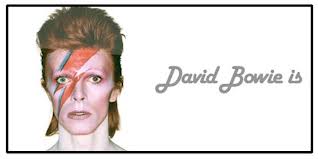
Review: 'David Bowie Is' - V & A Museum
If there could be a blueprint for how to mastermind the perfect cultural renaissance, David Bowie in 2013 may well have encapsulated that Lazarus ideal. Resigned to a hermetic hush since his 2003 brush with mortality, the last decade of retirement has only sporadically amplified into brief public appearances.
Taking the music world completely by surprise by announcing a new album in January was yet another major magic trick, a masterful coup d’etat, from the artist who, above all others in the second half of the 20th century, has been the conjurer at the forefront of surprise, shock and reinvention. Riding in the slipstream of fervent Bowie hysteria – fuelled by the unassailable fact that the album, when it arrived, was a remarkable return to form – the Victoria & Albert museum unveiled plans for a ‘blockbuster’ Bowie retrospective, with demand quickly outstripping availability. In the absence, for now at least, of any planned live appearances, this may well be the closest experience people will get.
And so, having pre-booked 3-and-a-half months in advance for one of the last remaining time slots, I went along on a scorching July weekday afternoon to experience for myself what critics had been clambering over each other to ladle on bountiful praise.
It certainly is a well-stocked and comprehensive exhibition of artefacts; clearly Bowie has spent his whole career hording costumes and stage props with a show of this magnitude in mind. It feels fresh and invigorating – big screens draw you in to various distinct eras of his career whilst relevant props are placed like satellites around the moving images. As you progress through, the corresponding music and commentary pieces are triggered via headsets. Although in principle this is an interesting concept, often I found the audio dropped in and out like a phone signal on a train, leaving me to try and reorient my position in order to spark the sound into life once again.
One of the prevailing impressions to be left with is the extent of Bowie’s constantly inquisitive, sponge-like absorption of the cultural landscape, his appropriation of whole swathes of influences, using and discarding them at will. From mime and performance art, to subversive literature (Ballard, Burroughs, Burgess et al), to Japanese costume design, Dadaist theatre of the Weimar Republic, nihilist philosophy (Nietzsche), to avant garde cinema (‘Metropolis’, ‘The Cabinet of Dr. Caligari’, etc.); all were experienced and siphoned through into his own artistic mission statements.
However, the exhibition is not without some flaws. The opening sections begin, predictably, by covering Bowie’s upbringing, roots and early musical endeavours, before moving onto his commercial break-through with the ‘Space Oddity’ album. After that the exhibition opens up both spatially and thematically, as though the curators suddenly decided to abandon any attempt at chronology. The effect of this diluting of any tangible cohesion is quite jarring, with costumes and stage props from the early-70s being placed side-by-side with those from the mid-90s, seemingly at random.
The other particular down-side was just how busy it was. Of course, this is to be expected with any ‘blockbuster’ exhibition and you are never going to enjoy the perfect viewing experience. But by allocating tickets according to specific time slots, and subsequently all tickets selling out, the result is that no matter what time you opt for, the attendance will be at a constantly high density. This could be overlooked were it not for the proliferation of so many small scale items of memorabilia, text plates and other miscellany that force you to effectively queue your way round them in a kind of frustrating assembly line. All this, realistically, then allows for is the most cursory of glances at items such as hand-written lyric sheets and photo negative strips that I felt warranted a lot more attention.
Of course it could be argued that such grievances are merely churlish given the event’s scale of publicity and the seemingly universal appeal of its subject. For any fan it is, undoubtedly, a treat to be granted such rare access to these treasures, and despite my misgivings, the undeniable outcome is to leave feeling even more in awe of a creative artist who imbues that oft misused, but in this case surely justified, label of genius.
Monday, 23 January 2012
REVIEW: A Life During Wartime - Don McCullin exhibition 'Shaped By War'
Don McCullin - 'Shaped By War'
(Imperial War Museum, London, 19th Jan 2012)
There is something about photography, some innate sense of actuality - a moment plucked from reality and frozen within the frame - that lends it an almost helpless objectivity. You may be forgiven for breezing through a gallery of artwork waiting for that revelatory discovery of brilliance to launch itself at you from the periphery, or for feeling disenchantment on viewing a painting held in lofty esteem by the masses. There is a certain element of self-investment in viewing art; what you get from it is often tangential to the mentality you approach it with. Because what we are viewing is purely the artist's representation of his private reality, rendered through skill and technique to canvas, it does require a certain amount of subjective engagement with the artist's vision.
Art leaves itself open to ambivalence and misconception. Photography, on the other hand, by its very nature cast in concrete verity (and therefore also because of the lesser demands on the viewer's own imagination in tandem with that of the artist's), demands a reaction.
Indeed it would be impossible to be ambivalent about the work of Don McCullin, photojournalist for 'The Observer' and 'The Sunday Times', and purveyor of some of the most visceral and harrowing war images of the 20th century. Sent to cover some of the most dangerous places in the world - from the Cypriot civil war, to Vietnam, the Londonderry riots, to Cambodia - the exhibition is perfectly encapsulated by its title. It is as much a study of the man behind the lens, a life well and truly 'shaped by war'.
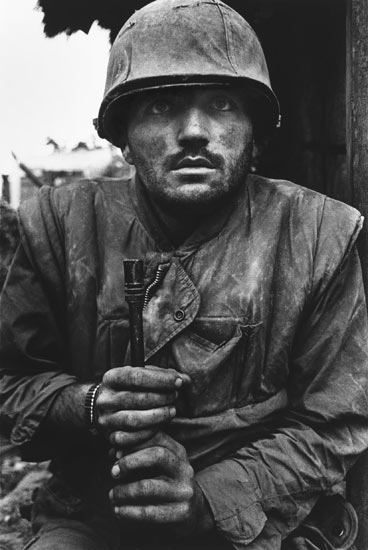
The horror and the intensity of the situations are scorched across every one of McCullin's well-crafted images. At times you can actually sense the panic and the chaos, the bullets flying overhead, the mud and the stench of fear. You stare at the photo of the shell-shocked soldier in Vietnam and you can almost hear the bombs punctuating the air around him like morse code. You stare at the famous image of the distraught Turkish wife (which won him the World Press Award in 1964) and can almost taste the bitter despair crystallised in a moment of raw human emotion.
Of course no photograph can capture the sheer terror of the situations as witnessed first-hand. Watching the accompanying documentary film, McCullin admits to an 'uneasy enjoyment' of his time spent in such hostile environments. In a way this is perfectly understandable. The level of tension and adrenalised energy that must be exerted and relied upon whilst immersed in a war zone, where the next bullet or mortar blast could be the one that claims you, must be undeniably potent and surely have intoxicating agencies. In the same way as the motor-sport driver, stunt pilot or daredevil straddles the boundary of mortality, the thrill of emerging on the other side alive must be as compulsive as any drug.
As with any member of the armed forces, constantly exposed to such extreme situations from which they may not survive, the succumbing to combat neurosis and the readjustment process once back home must be disorientating and harsh. Indeed, McCullin once said - 'when I was at home away from war, I was unhappy'. This must have invoked his obsessive urge to dive back into the ferocity of the front line, to re-engage with danger time and again; and perhaps elucidates his anger (alongside obviously a sense of professional pride) when refused a press pass to cover the Falklands conflict and his regret at having visited but 'not seen any action' in the Gulf war.
This is not to suggest any perverse revelling in such situations, but instead demonstrates a burning desire to be at the epicentre of the event, thereby capturing it as accurately, honestly and unflinchingly as possible. It is only natural that one's psychology be permanently altered by the exposure to murder and destruction on such a grand scale. By comparison, normal everyday life must forever after assume a kind of removed and faded tonality, akin to underdeveloped photo film in a dark-room.
One of the pervading emotions McCullin expresses throughout his story is of a sense of guilt. A guilt at being in such close proximity to men killed for their country, and being forced by professional duty to stay emotionally detached, remain partisan and capture the moment as truthfully as able. As he says, 'what a way to make a living!' His yearning to 'do his bit' is emphasised in moments such as when, embroiled in the Battle of Hue, he carried a wounded solider out of the firing line. He also described feeling like 'a Judas to both sides' when covering the Londonderry riots in Northern Ireland.
Ultimately though, this is misguided guilt, albeit also perfectly understandable. The overriding lesson to be gleaned from the exhibition is just how necessary and vital photojournalism is in terms of throwing bright light on the darkest of human endeavours. With the rise of 21st century 'citizen journalism', where anybody with a camera phone can assume a McCullin-style role, the importance of responsible and unbiased representation cannot be understated.
However they enter the public domain, we must feel an obligation to view these images, regardless of how distressing, in order that we might be afforded a more salient understanding of the events as they happened, but never allow them to lull us into complacent acceptance, thereby neglecting to ponder the reasons why the events had to happen at all.
Subscribe to:
Posts (Atom)